
There’s a moment that continues to stand out in a school in Ho Chi Minh City. A student, mid explanation in a geography lesson, pauses, switches briefly into Vietnamese to test an idea with a peer, then returns to English to articulate a more precise answer to the class. It is fluid, purposeful, and completely natural.
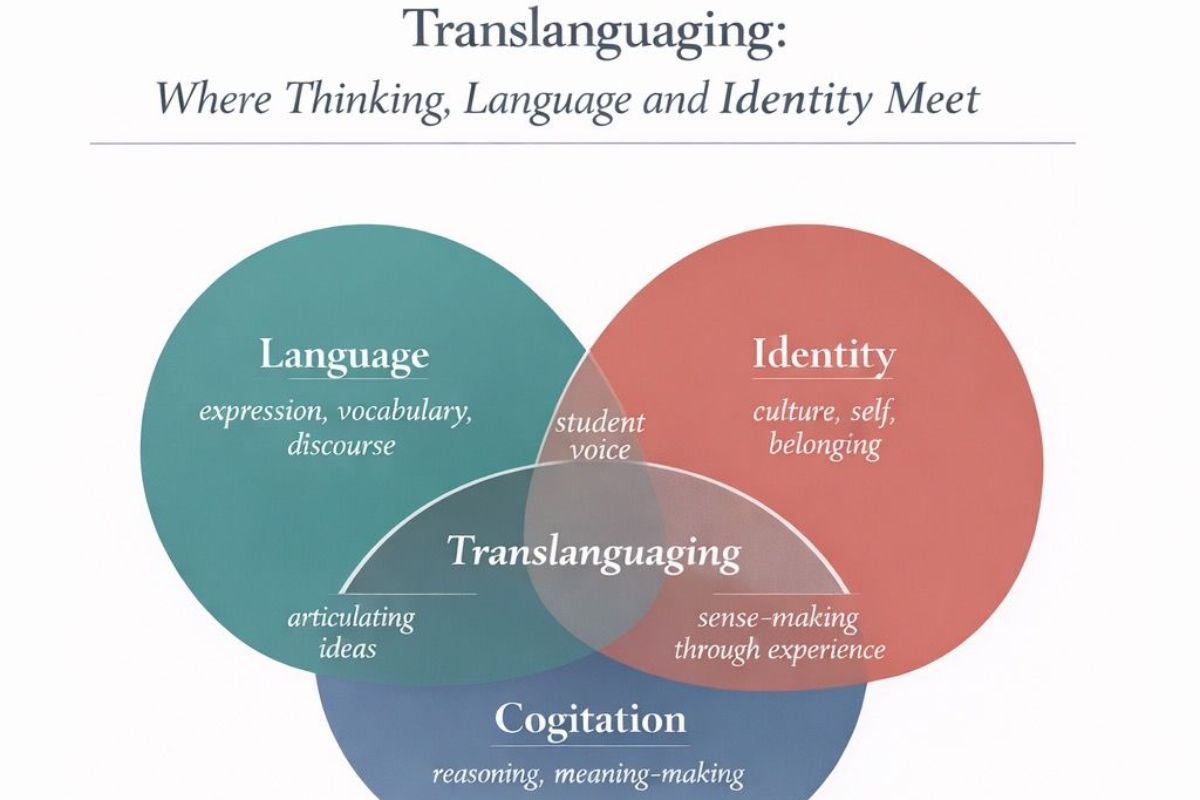
Five years ago, this practice may have been discouraged. Now, it is celebrated. There was once a quiet assumption that “good learning” in an English medium school meant full immersion in English at all times. That assumption is increasingly being challenged across international schools in Asia. Translanguaging refers to the use of a learner’s full linguistic repertoire to make meaning, express identity, and participate in learning.
Understanding Translanguaging
Translanguaging is not new. While the term has earlier roots, it was the seminal work of Ofelia García and Li Wei (2014) that established it as a powerful framework for multilingual classrooms. What is changing is where it is being seen. Increasingly, it is becoming embedded within schools as an element of belonging and a driver of student learning. The most forward thinking international schools are now placing it at the centre of their commitment to diversity.
Students have always been translanguaging. The real question is whether it is recognised, designed for, and valued. In Vietnam, as in many parts of Asia, classrooms are linguistically rich. Students move between English, Vietnamese, Korean, and other languages daily. Monolingual norms do not reflect how students actually think, nor do they capture the complexity of multilingual cognition. Using a full linguistic repertoire is not a shortcut. It is a strength. Translanguaging reflects the idea that clarity of thought can come before fluency of expression.
From Policy to Practice
Within teaching and learning frameworks, there is a growing shift towards recognising linguistic diversity as an asset rather than a barrier. While subtle in policy, this shift is powerful in practice. It signals to teachers that multilingualism is not something to be controlled or reduced, but something to be used to deepen thinking, understanding, and belonging.
Translanguaging is not about lowering expectations or “letting students off the hook” linguistically. It recognises that cognition does not occur neatly within one language. It is layered, complex, and closely tied to identity.
This aligns with the work of Jim Cummins, who advocates for additive rather than subtractive approaches to language learning (2021). In this perspective, students’ home languages are developed alongside English rather than replaced by it. The aim is to strengthen understanding of academic and subject specific language while maintaining engagement with literacy across languages. At its core, this approach affirms students as cognitively capable, not despite their multilingualism, but because of it.
Small Shifts with Significant Impact
In practice, small adjustments can make a meaningful difference. Students may be encouraged to rehearse ideas in their first language before sharing in English. Paired discussions can allow learners to clarify concepts in the language that enables the most precise thinking. Key vocabulary is taught explicitly, while space is also created for meaning making before language is fully formed.
Multilingual learners are engaging with complex ideas. They are not simply searching for the right words.
Research by Angela Creese and Adrian Blackledge (2010) highlights the importance of creating classroom environments where all language practices are valued. Translanguaging extends beyond strategies and into the cultural and relational fabric of learning environments.
García and Wei further argue that translanguaging pedagogy is deeply connected to identity (2014). They emphasise the development of sociocultural identities, underpinned by creativity and criticality. Creativity involves knowing when to follow or challenge linguistic norms. Criticality involves the ability to question, analyse, and respond thoughtfully to cultural and linguistic contexts. When classrooms validate students’ full linguistic repertoires, they enable learners to shape and reshape their identities as thinkers.
Translanguaging and Equity
This has important implications for equity. In many international schools, inclusion is widely discussed, yet language policies can unintentionally exclude. English only expectations, when applied without flexibility, can limit opportunities for students to demonstrate understanding, restrict participation, and reinforce deficit views of multilingual learners. They may also require students to leave parts of their identity outside the classroom.
What becomes clear is that this shift requires more than permission. It requires intentional design. Teachers need to understand when translanguaging supports learning and when it may conceal misunderstanding. It is not unstructured or random. It is a deliberate pedagogical choice, grounded in research and professional judgement.
Language, Identity and Belonging
At its core, translanguaging highlights the connection between language, identity, and learning. When classrooms are designed to value every linguistic repertoire, access to the curriculum improves. More importantly, a sense of belonging is created that enables students to think deeply, contribute meaningfully, and thrive.
References
Cummins, J. (2021) ‘Translanguaging: A critical analysis of theoretical claims’, in Juvonen, P. and Källkvist, M. (eds.) Pedagogical Translanguaging. Bristol: Multilingual Matters.
Creese, A. and Blackledge, A. (2010) Translanguaging in the bilingual classroom: A pedagogy for learning and teaching? The Modern Language Journal, 94(1), pp. 103 to 115.
García, O. and Wei, L. (2014) Translanguaging: Language, Bilingualism and Education. Basingstoke: Palgrave Macmillan.