Home > Lifestyle > Beyond Travel > Travel Far > Dulwich College Singapore Deputy Head Chris Timms Completes Top Finish at Marathon des Sables Desert Race
Dulwich College Singapore Deputy Head Chris Timms Completes Top Finish at Marathon des Sables Desert Race
Singapore-based ultrarunner Chris Timms reflects on the unforgettable experience of completing the Marathon des Sables across the Sahara Desert
From Singapore’s humid trails to the silence of the Sahara, Chris Timms reflects on resilience, family and discovering what is truly possible at Marathon des Sables
Chris Timms, Reflecting on Desert racing, Resilience, Family, and the Strange Silence of the Sahara
There are races that test fitness. There are races that test resolve. And then there is the Marathon des Sables, a seven-day, self-supported journey across the Sahara Desert that has built its own mythology over four decades.
For Chris Timms, Singapore-based ultrarunner, teacher, father, and familiar face within the Falcons running community, the 40th edition of the race was more than another finish line. It was a childhood dream, five years deferred, finally made real.
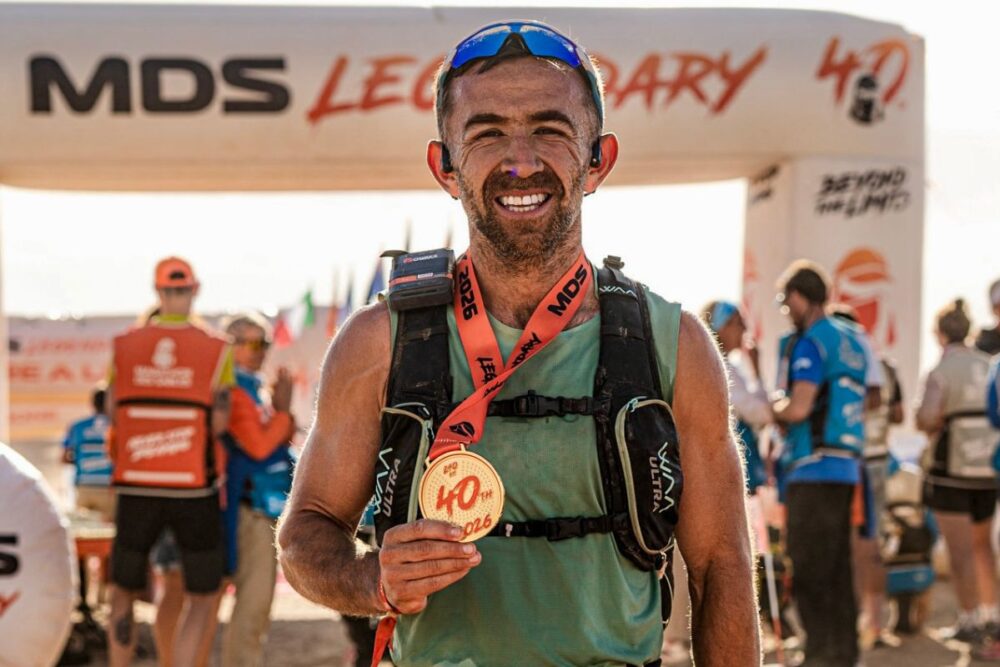
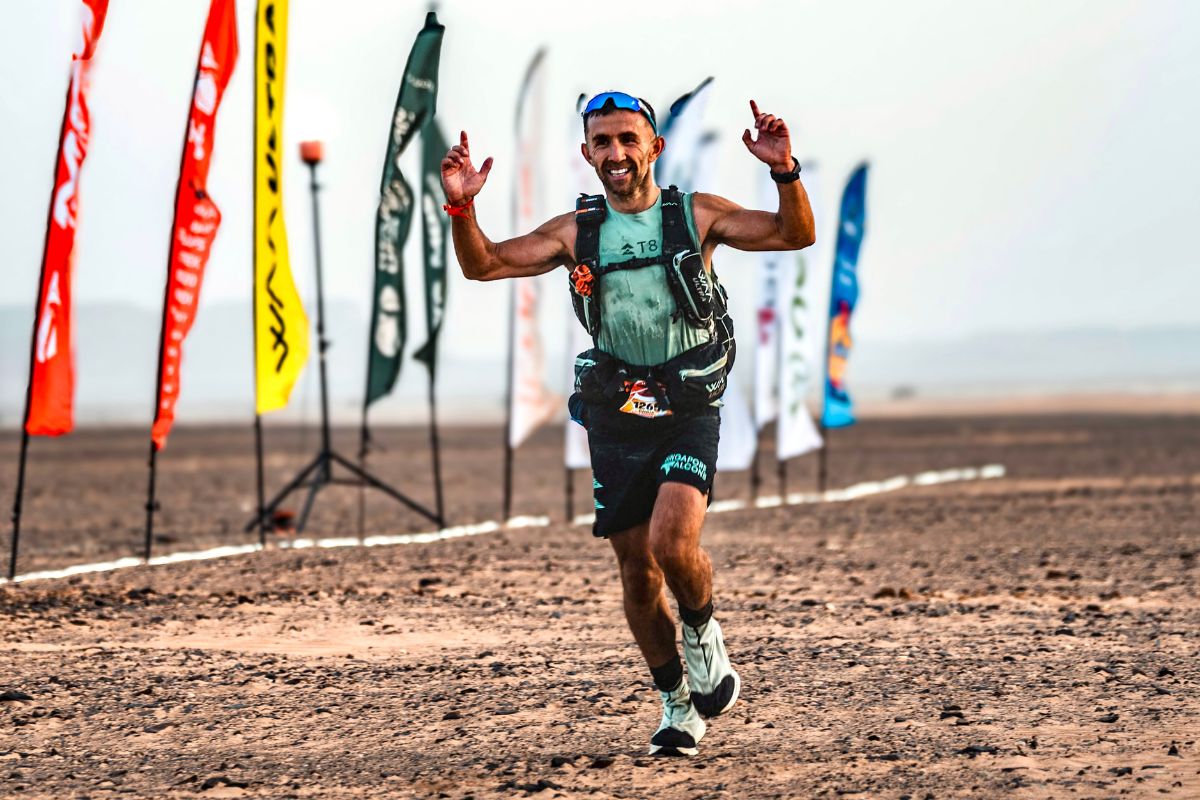
Against a field of more than 1,500 runners from across the world, Chris finished 30th overall, first from Asia and second Brit, placing inside the top 2% of one of the toughest endurance races on Earth. Over six days and roughly 270 kilometres across the Sahara Desert, competitors carried everything they needed on their backs while battling extreme heat, sandstorms, sleep deprivation and relentless terrain. But for Chris, the achievement was never really about position. It was about resilience, adaptation, community, and discovering just how much more the mind and body are capable of when stripped back to the essentials. Chris says,
“Running can be a very spiritual thing. There’s something about endurance running that strips life back to its essentials, out there, away from the noise and distraction of the world, you reconnect with what really matters.”
That feeling, carried through heat, sandstorms, silence and exhaustion, became one of the defining threads of his Marathon des Sables experience.
Marathon des Sables 2026: resilience tested in the world’s toughest desert race
A Childhood Dream, Forty Years in the Making
Chris first saw the Marathon des Sables on television as a child in the UK. He remembers watching a BBC documentary at around eight years old and thinking the whole thing looked impossible.
“Back then you just think, ‘Wow, people are crazy.’ Then a few years on, you realise, ‘Wow, I am one of those people now.’”
His endurance journey did not begin in the desert. It started with Ironman, after being persuaded by a friend, Clive Bolton, to take on the distance before he had even completed a triathlon. From there he progressed into marathon running, then ultra running, and eventually became part of Singapore’s trail and ultra endurance community. Yet the Marathon des Sables always remained in the background as a long-held ambition.
Chris originally signed up for the race in 2020, but COVID, work commitments and school holiday schedules repeatedly pushed the event further into the future. As a teacher, timing was crucial, and the race needed to align precisely with the Easter break.
When the school holiday dates were confirmed and aligned with the event, everything finally fell into place, making it the right moment to commit. Five years after first entering, he was finally on the bus heading into the Sahara Desert.
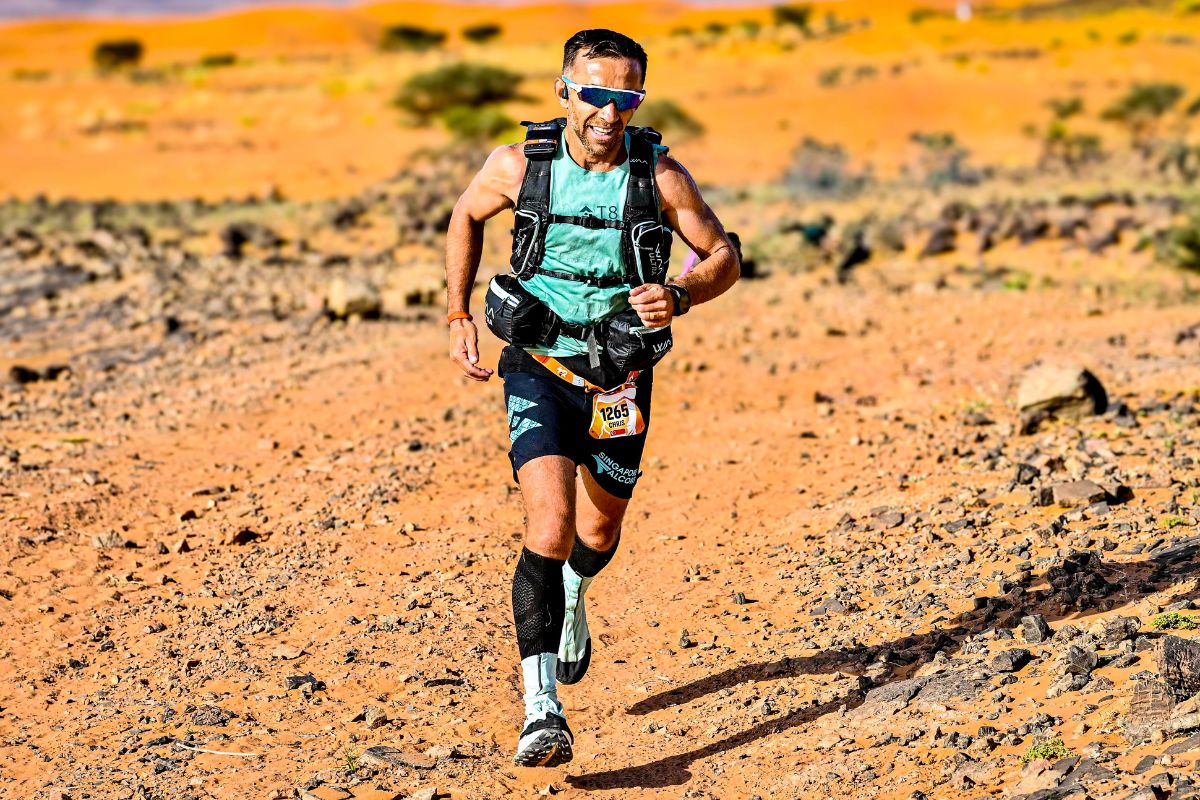
From Singapore’s humidity to the Sahara’s dunes, Chris Timms embraced the challenge
What Makes MDS Different?
The Marathon des Sables is often described as one of the toughest foot races in the world. For its 40th edition, the race was extended to around 270 km rather than the usual 250 km, with an additional 100 km long stage added to mark the anniversary. The format sounds simple on paper but is relentless in reality: six stages over seven days, with runners required to carry all their own equipment, sleep in open-sided bivouac tents, and survive on rationed water supplied by the organisers.
Competitors must carry everything themselves, including clothing, food, nutrition, mandatory safety kit, and any personal extras, with water the only provision provided along the route. There is also no detailed GPX file shared beforehand. Instead, runners are handed a traditional route book on the bus before the race begins, revealing distances, elevation profiles, and navigation notes only at the last moment as anticipation builds among participants.
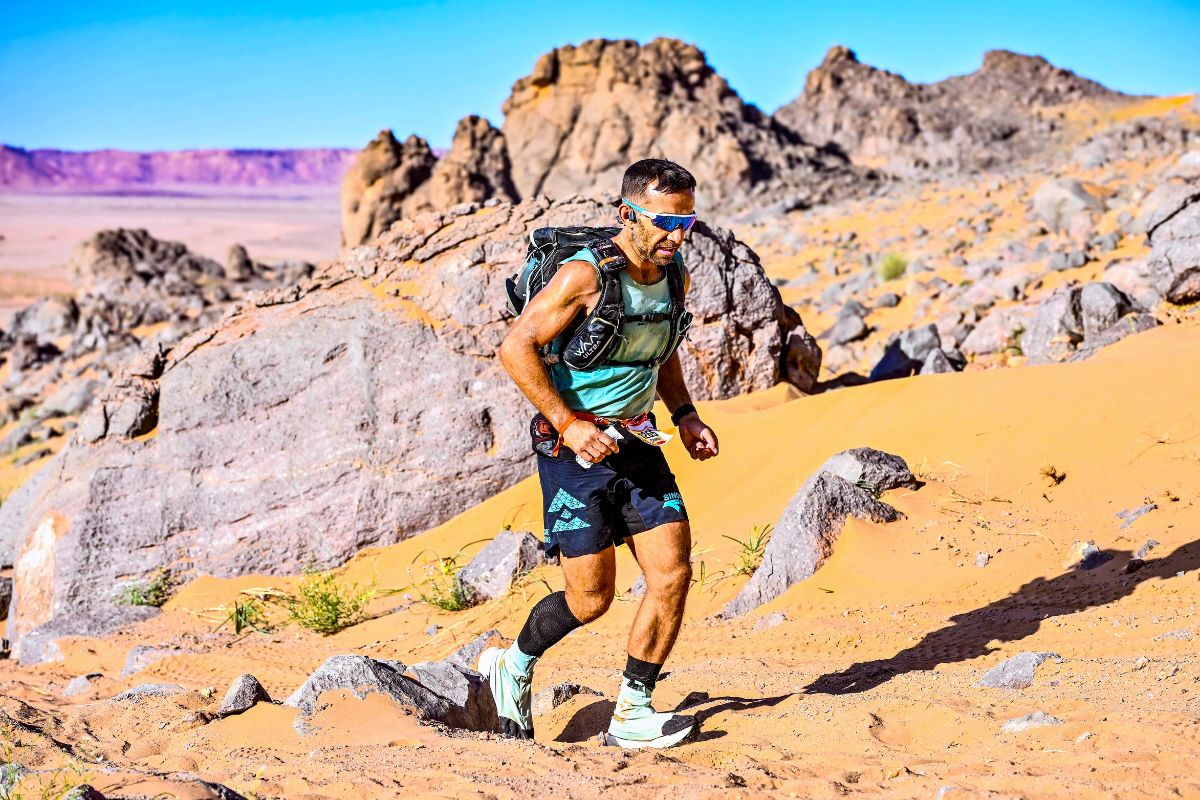
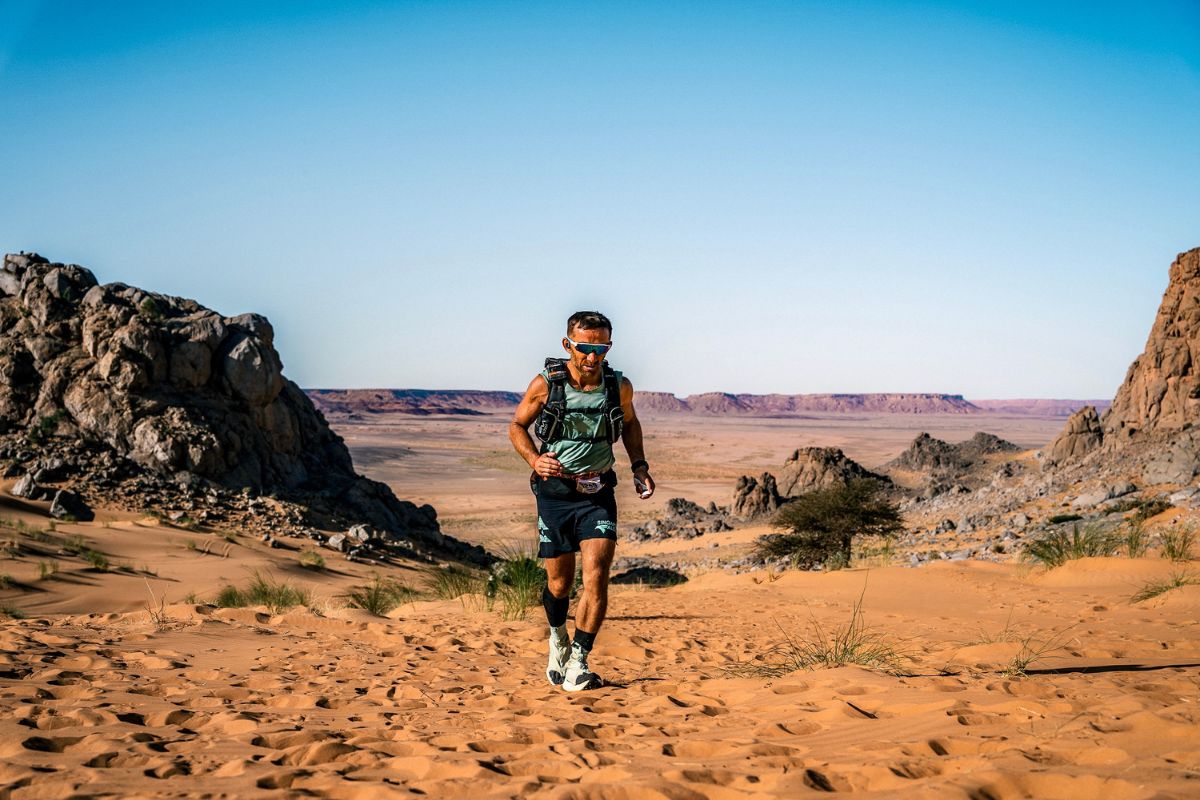
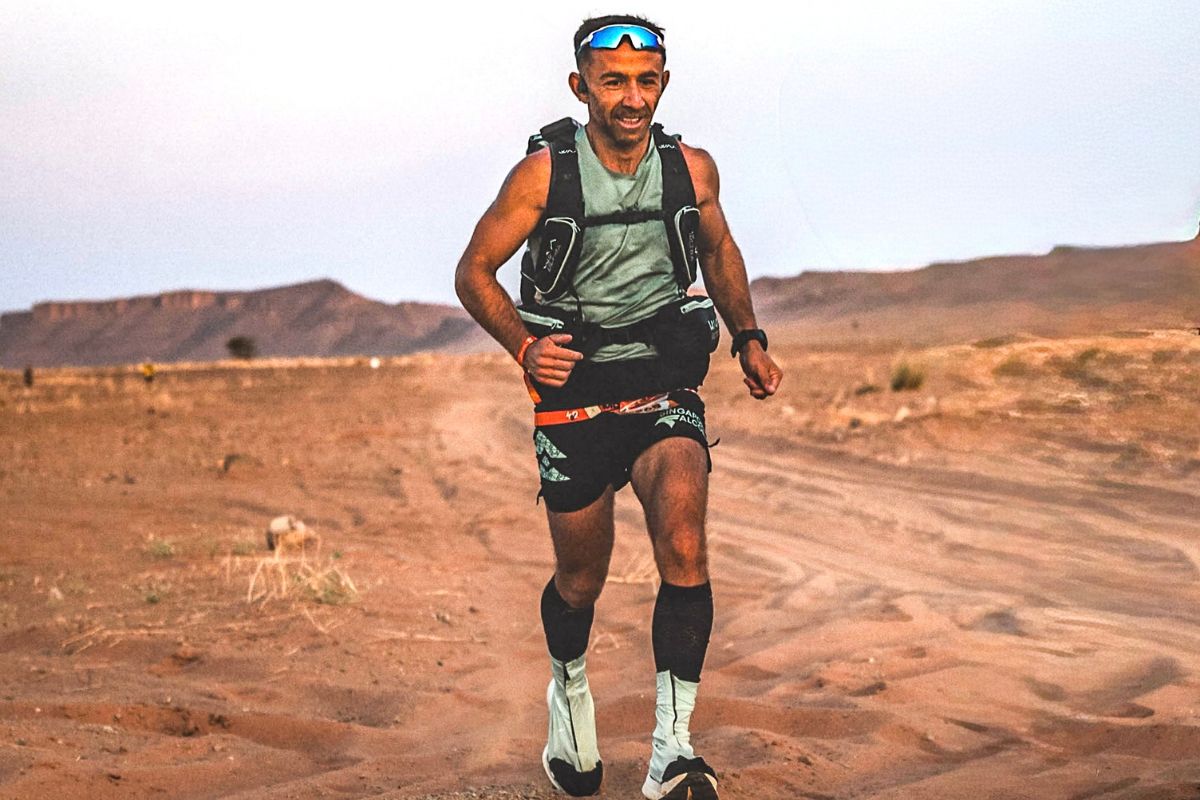
The course crosses eastern Morocco near the Algerian border, taking runners from bivouac to bivouac through vast dunes, rocky plains, and desert tracks. Some stages loop back to camp, while others are point-to-point crossings through remote terrain. For Chris, who had never experienced the desert before, the scenery was unlike anything he had seen, with towering sand dunes and dramatic landscapes that felt like something from a film set, completely isolated from civilisation yet unforgettable in their beauty.
Step by step through the Sahara, Chris Timms turned a childhood dream into reality
Training for the Desert from Singapore
Preparing for the Marathon des Sables from Singapore presented obvious challenges. There was heat, but not the dry, relentless conditions of the Sahara. There was humidity, but no true desert climate. There were beaches, but nothing resembling endless dunes.
Chris felt the race was almost impossible to fully prepare for unless someone had experienced it before, lived in those conditions, or competed multiple times. While certain types of training could provide an advantage, nothing could truly replicate the demands of the desert itself.
What surprised him most was that Singapore’s intense humidity may actually have become an unexpected advantage. He found running in 40-degree dry heat easier than training in 35-degree temperatures with 90 per cent humidity. After arriving in Morocco a week early to acclimatise, he quickly realised he may have been better off staying in Singapore’s harsher training conditions for longer.
His preparation focused on building volume, adapting to heat, training on tired legs, and running with weight. Weekly mileage regularly reached between 80 and 90 kilometres, with many sessions taking place at lunchtime along Singapore’s Green Corridor while his son, Isaac, cycled alongside him.
Training in Singapore’s oppressive humidity also made the desert feel more manageable, as sweat could evaporate properly in the dry air rather than sitting heavily on the body.
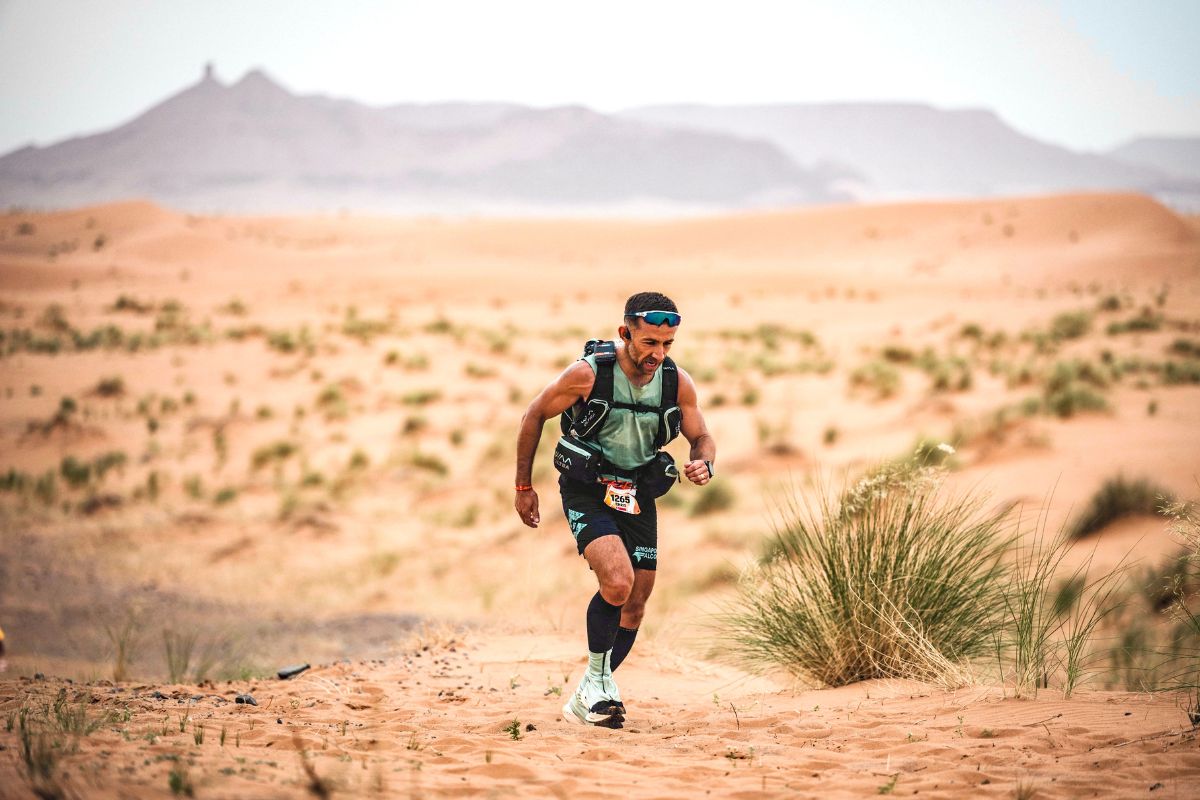
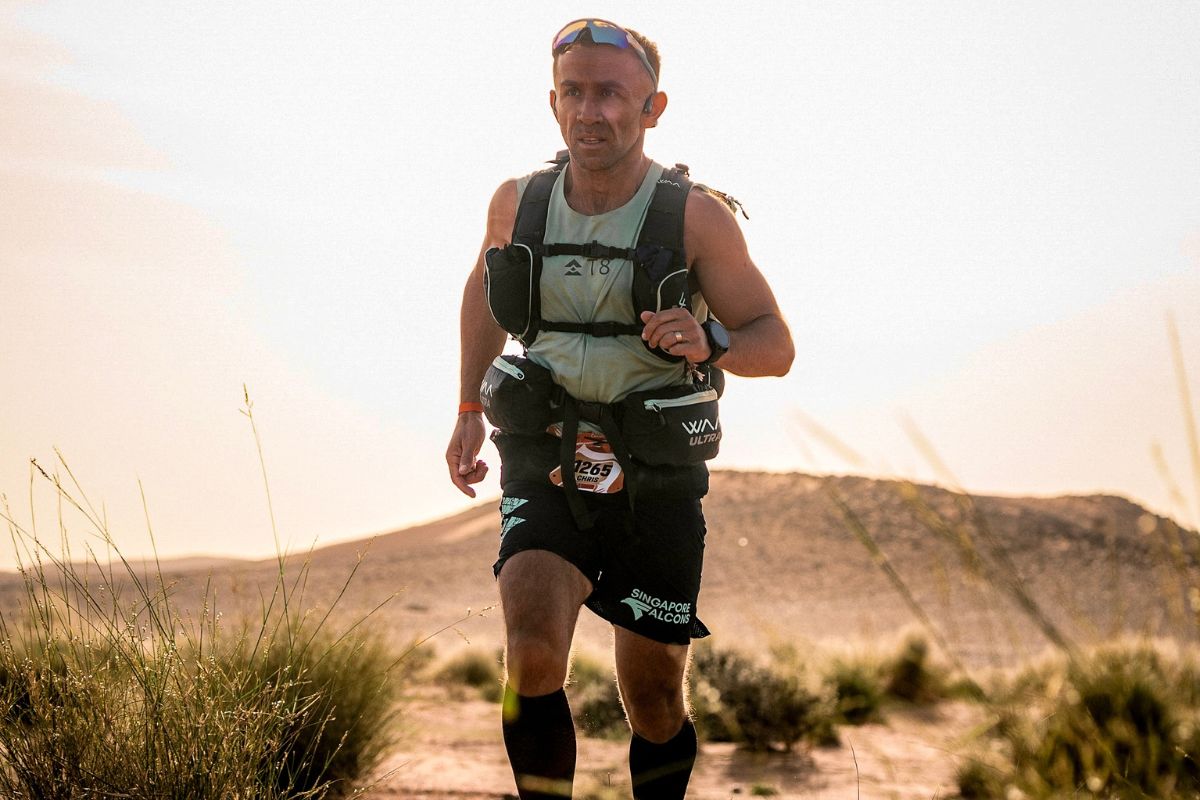
Even so, the sand itself was a completely different challenge. Every footstrike shifted beneath him and every dune required constant adjustment. Chris quickly recognised that the strongest competitors were not necessarily the fittest, but those who adapted the fastest. Success depended on learning continuously during the race itself adjusting cadence, choosing better race lines, managing the backpack effectively, and understanding how to move with the wind and terrain rather than against it.
One of his biggest physical lessons came through the strain the sand placed on the body. Running across dunes heavily taxed the quadriceps, adductors and abductors in a way he had never previously experienced.
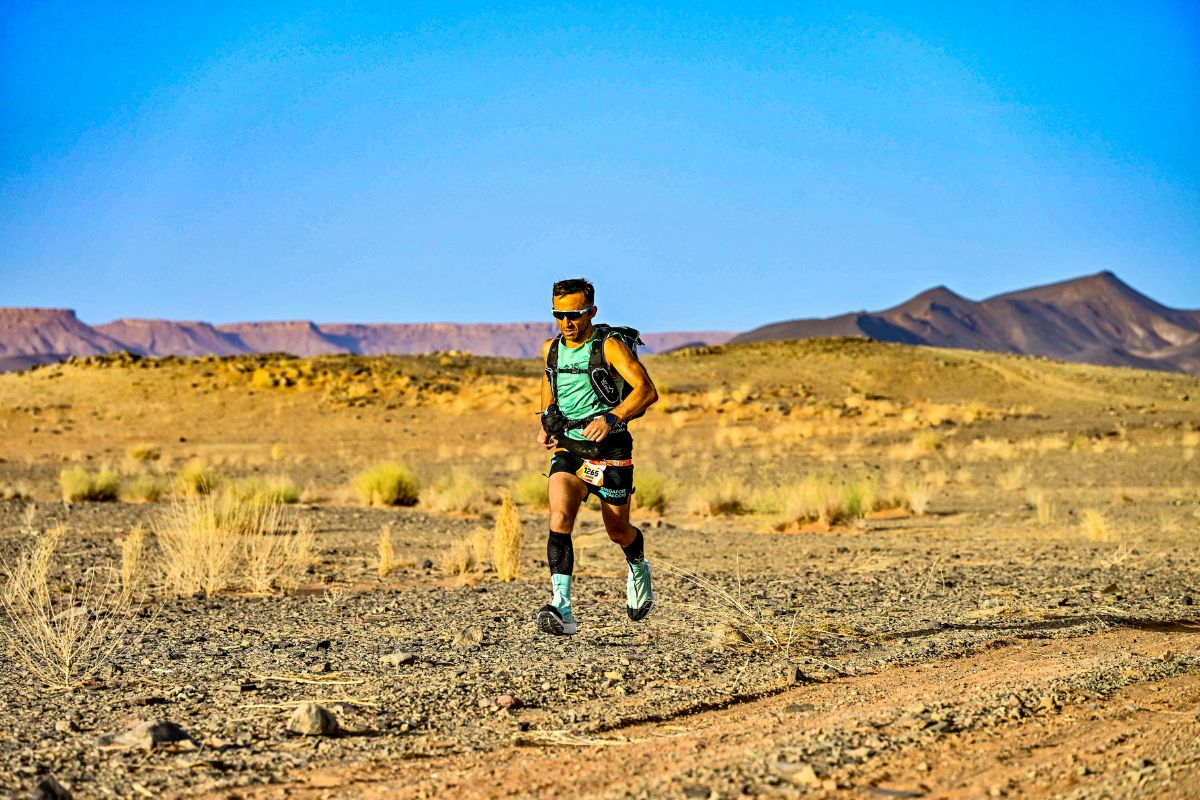
Through sandstorms and scorching heat, Chris Timms kept moving forward
The Kit Gamble
The Marathon des Sables is as much a logistical and equipment challenge as it is a running race. Every item comes at a cost, with competitors required to carry their own food, sleeping bag, stove, spare clothing, medical supplies and mandatory safety kit throughout the event. Chris opted for an extremely lightweight approach, starting the race with a pack weighing around 6.8 kg, close to the minimum permitted weight, while some runners began with bags approaching 20 kg.
He adopted the mindset that each day the load would become easier, as the bag gradually became lighter through consumed food supplies while his body simultaneously grew stronger and fitter as the race progressed.
To reduce strain on his shoulders, Chris used T8 shorts designed to distribute weight around the waist. He also selected soft water bottles instead of rigid plastic ones, allowing them to collapse and disappear neatly into the pack once empty rather than bouncing around while running. His overall strategy was built around familiarity and simplicity. He relied on Adidas Terrex shoes, gaiters that had been sewn onto the shoes in Singapore, and Squirrel’s Nut Butter to manage chafing and protect his feet. Most importantly, he avoided making any major changes or experimenting with untested gear before the race, believing the best advice he received was to avoid doing anything differently from his normal ultra-running routine.
Despite the careful preparation, problems emerged almost immediately. Within the opening kilometres of stage one, the straps on his backpack failed. Chris had previously trimmed excess webbing from the straps because of his smaller frame and the amount of loose material hanging from the pack. In doing so, he had unknowingly removed the section that prevented the straps from slipping back through the fastening system.
One strap failed, then shortly afterwards the second followed, leaving him convinced that his race could be over before it had truly begun. The situation became emotional very quickly as he feared months of preparation had unravelled within the first stage.
Help came from another competitor, a German runner named Hans, who handed him a shoelace. Chris used it to tie the pack together securely enough to finish the stage before spending the evening in the bivouac transforming the tent area into a makeshift repair station using cable ties and improvised fixes.
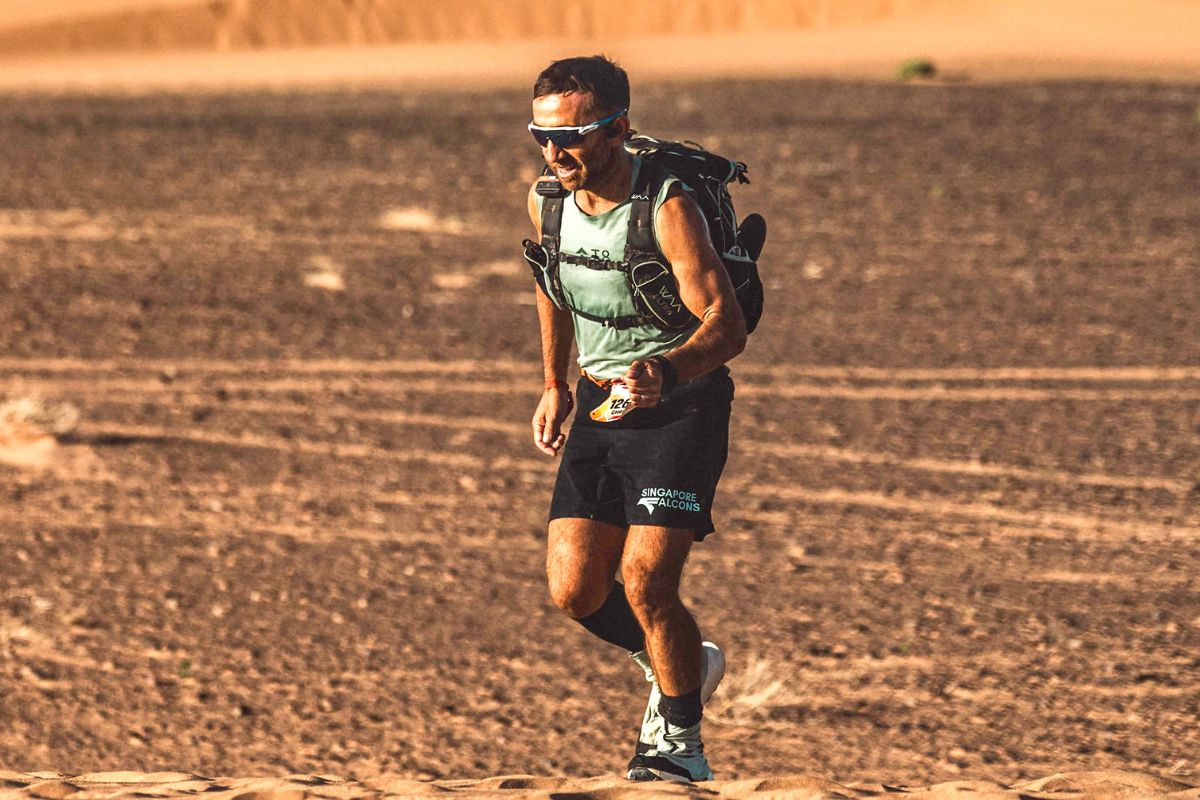
The desert strips life back to its essentials, one step at a time
Food, Hunger and Cold Meals
Chris made one major decision to reduce weight by choosing not to carry a stove. All of his meals were eaten cold because he did not want the additional burden of carrying cooking equipment and firelighters across the desert.
His nutrition strategy focused on lightweight, calorie-dense freeze-dried foods, including couscous, beef stroganoff, muesli, protein porridge, granola and nuts. Every meal was carefully repacked into plastic bags with the calorie count written clearly on the outside. The race regulations require competitors to carry a minimum of 2,000 calories per day, and Chris chose to stay close to that limit. Looking back afterwards, he realised it had probably not been enough and estimated he would have benefited from carrying closer to 2,500 calories per day. By the final stage, he had completely run out of food.
Like many runners in the desert, he eventually had to rely on the support of others. Word spread quickly through the bivouac, and fellow competitors began arriving at the tent asking whether he was the runner who needed food.
That became one of the defining realities of the Marathon des Sables. Although every participant was enduring their own physical and mental struggle, there was also a remarkable sense of generosity and shared resilience throughout the race. Toothpaste, paracetamol, food, hot water and practical advice were all exchanged freely among runners trying to help one another reach the finish line.
In the silence of the Sahara, Chris Timms found strength, purpose and perspective
A Race Full of Stories
Around 1,500 runners lined up for the 40th edition of the Marathon des Sables, and Chris described them as some of the strongest-minded people he had ever encountered. Every runner seemed to carry a personal story or motivation for being there, whether connected to family, legacy, charity, personal challenge or something deeply individual. The field included elite athletes, walkers, amputees, charity runners, first-time competitors and experienced veterans of the race. Some looked capable of competing for victory, while others appeared to be giving absolutely everything simply to reach the finish line.
Withdrawals happened daily as the desert steadily wore people down. Blisters, extreme heat, lack of food, missed cut-off times and damaged footwear all contributed to runners leaving the race. The overall drop-out rate appeared close to the usual figure of around 10 per cent. Yet for Chris, some of the most memorable moments came not during the stages themselves, but afterwards when the day’s final competitors approached camp.
At the end of each stage, a bell would ring to announce the arrival of the last runners. Competitors would emerge from their bivouac tents and gather together to cheer them across the line. Chris felt these runners were often the true heroes of the race, not necessarily those finishing in a few hours, but the people enduring relentless suffering deep into the heat of the day and refusing to give up. A camel acted as the moving cut-off marker throughout the race, and any runner falling behind it risked elimination. Some competitors spent day after day only a few steps ahead of the camel, fighting simply to stay in the event.
Among the most emotional moments for Chris, were watching the amputee runner continue through the desert and seeing Leo, a 12-year-old boy whose family pushed him in a wheelchair and took turns carrying the effort together across the stages. In a race where most people arrived focused purely on their own survival, the sense of community and shared resilience became one of the defining parts of the experience.
Heat, sand and silence. Chris Timms pushing forward at Marathon des Sables
Tent 142
Chris’s home for the week was Tent 142, shared with a group of eight runners from across Asia and beyond. The tent brought together competitors from Singapore, Taiwan, the Philippines, Korea, India and Nepal, forming a diverse group that quickly developed into a close-knit family unit over the course of the race.
For Chris, the atmosphere inside the tent became one of the highlights of the entire experience. There were no egos or rivalries, only a strong sense of mutual support as everyone helped one another through the physical and mental demands of the desert.
Among the group was Santosh, a physiotherapist from Nepal who became invaluable in helping tired and damaged bodies continue functioning throughout the week. There was also Joffrey from Singapore, who Chris believed would soon become part of the Falcons community. The tent included runners with a wide range of coaching backgrounds, racing experience and personalities, along with enough humour to keep morale alive even during the hardest stages.
Living together in such close conditions created unusually strong bonds in a very short period of time. With little to do beyond eating, recovering and preparing for the next stage, conversations naturally deepened and friendships formed quickly.
The simplicity of life in the bivouac stripped daily existence back to its essentials. There was no Wi-Fi, no endless scrolling and no outside distractions. Days revolved around food, recovery, dust, sunsets, conversation and mentally preparing for whatever the desert would bring next.
Chris also felt the Marathon des Sables created a rare sense of equality between competitors. In few other races would ordinary runners find themselves living side by side with elite athletes such as Des Linden and André Schürrle, sharing the same toilets, tents and harsh conditions. Regardless of reputation or background, everyone faced exactly the same environment once they entered the desert.
Running With the Elites
Chris spent much of the race alongside elite female competitors and experienced European runners, constantly observing how they approached the demands of the desert. He paid close attention to the way they moved through aid stations, adjusted their cadence on sand, tackled climbs, managed their backpacks and stretched during recovery, treating every stage as an opportunity to learn.
On firmer and flatter sections of the course, he felt capable of matching the pace of many of the leading runners. However, the difference became far more apparent once the course entered deep, soft sand. The elite competitors seemed to glide effortlessly across the dunes, while others would suddenly lose momentum as though they had run into an invisible barrier.
One of Chris’s biggest lessons from the Marathon des Sables was realising that fitness alone was only one element of performance. Technique, efficiency, decision-making and the ability to adapt calmly to changing conditions proved just as important as physical strength.
He ultimately finished 30th overall, seventh in a highly competitive M1 age category, second among British runners and the leading runner based in Asia. It was a remarkable performance in a field made particularly strong by the race’s 40th anniversary edition.
Although proud of the result, Chris remained reflective about his performance. Looking back, he believed he probably had around 10 per cent more effort available during each stage, but acknowledged that he could only recognise that safely after successfully completing the race. Managing the balance between ambition and restraint became one of the defining features of his approach throughout the event.
Rather than risking exhaustion or collapse by pushing beyond his limits too early, he preferred to finish consistently strong across the stages. Having now experienced the unique demands of multi-stage desert racing, he felt it was highly likely he would return to take on another stage race in the future.
Every dune told a story. Every step proved the impossible was possible
Running to Remember
Alongside the physical challenge of the Marathon des Sables, Chris used the race to raise funds for the Samaritans and support suicide prevention work. He raised $5,000, an amount the charity estimated could help fund 243 potentially life-saving calls. For Chris, even if the fundraising contributed to helping just one person, the effort would have been worthwhile.
The race also carried a deeply personal meaning. Chris was running in memory of important people who were no longer with him, people with whom he had once spoken about taking on the Marathon des Sables. Carrying those memories into the desert gave the experience an added emotional depth and purpose.
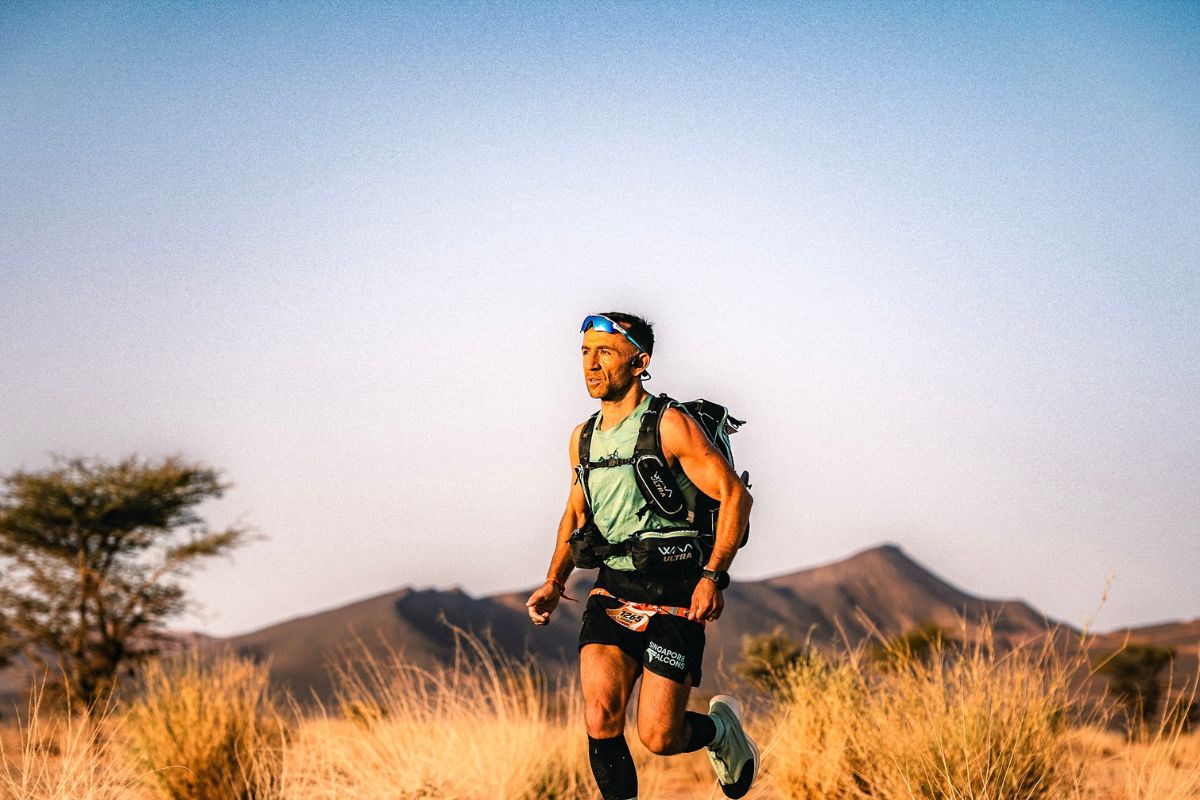
In the silence of the Sahara, he found the race stripped life back to its most basic elements. The environment felt almost spiritual at times, becoming part of the rhythm of the running itself. Unlike forests or cities, the desert offered almost complete silence. With no trees or buildings for the wind to move through, even strong gusts across the dunes created very little sound. For Chris, those moments brought an unusual sense of peace.
Running, he felt, had always represented something far greater than physical fitness alone. Endurance running in particular had a way of removing the noise and distraction of everyday life, allowing a reconnection with what truly mattered.
The Hardest Part
Although the heat, sand, food shortages, equipment management and distance all posed enormous challenges, the hardest aspect emotionally was the separation from home. During the race, Chris was only able to send brief one-minute video messages through the organisers’ communication system and could not receive replies in return.
That lack of connection proved more difficult than any physical hardship. He realised he had never previously spent so long away from his children without being able to exchange messages or hear back from them directly.
Throughout the week, he had no real sense of what was happening at home, how people were following the race, or even exactly where he stood in the rankings until printed results were released the following day. Life inside the Marathon des Sables became a complete bubble, isolated from the outside world. Each stage ended with runners saving their watches, switching off their phones and returning to the bivouac without truly knowing how they had performed compared with others.
In many ways, that disconnection only reinforced how central family remained throughout the experience.
Carrying everything on his back except doubt
Anyone Can Do This
One of the biggest misconceptions about the Marathon des Sables, Chris believes, is the idea that it is only suited to elite athletes. Over the course of the race, he became convinced that ordinary people are capable of far more than they often believe.
Throughout the week, he watched competitors who did not necessarily look physically suited to such an extreme challenge continue finding a way forwards day after day. What stood out to him was that mental resilience mattered far more than appearances or natural athletic ability. In his view, success in the desert was overwhelmingly psychological, with the ability to keep going often determined long before the body had truly reached its limits.
The race stripped life back to something very simple. Each day revolved around eating, recovering, continuing to move and solving whatever problem came next. Chris felt the human body was remarkably adaptable when exposed gradually to challenge, fatigue, discomfort and increasing physical load. Given time, it finds ways to cope with demands that initially seem impossible.
For him, this gradual transformation is part of the appeal of endurance sport itself. The process slowly changes both body and mind until challenges that once appeared unimaginable begin to feel normal. He believed many people stop not because their bodies fail, but because their minds convince them they cannot continue long before they have truly reached their physical limit.
Why MDS Changes People
Chris is careful not to romanticise suffering for its own sake, yet he understands why so many runners describe the Marathon des Sables as a life-changing experience. The challenge extends far beyond running alone. Competitors must manage their equipment, carry their belongings, sleep in difficult conditions, recover properly, deal with cold nights, ration food and constantly solve practical problems while exhausted.
Across the week there were sandstorms, broken backpack straps, Tailwind nutrition powder blown away by the wind at aid stations, swollen feet, damaged shoes, blisters and freezing nights in the bivouac. Yet alongside the hardship there was also stillness, humour, shared meals, elite athletes living alongside everyday runners, and strangers helping one another reach the finish line.
At the start of the race, commentator Ian Corless told competitors that the experience would change their lives. By the end of the event, Chris understood exactly what he meant. Certain races, he felt, have the power to change people because of the experiences they force competitors to endure, overcome and share together.
Across the endless dunes, Chris Timms discovered what endurance really means
What Comes Next?
For now, there is Rinjani, Chris’s only previous DNF, and therefore unfinished business. He will return to take on the 60 km route, carrying confidence from the Sahara and a little more knowledge about how his body responds when tired. Beyond that, more stage racing feels likely.
He is also keen to share what he has learned with others in Singapore who may want to take on MDS in future.
“Anyone who has got through something like Four Trails or MDS has expertise that can help someone else get over the line. You want to bottle that and share it.”
There are plans for an MDS-focused run at MacRitchie and a presentation at Red Dot Running Company, with other finishers and organisers helping to grow interest in the race across Singapore. Chris’s final reflection is simple.
“I would love everyone to feel what I felt on that finish line, achieving something you once thought was impossible.”
For a race born in the desert, perhaps that is its real pull. Not the heat. Not the sand. Not even the distance. But the chance to discover, step by step, that the impossible was never quite as fixed as it seemed.