
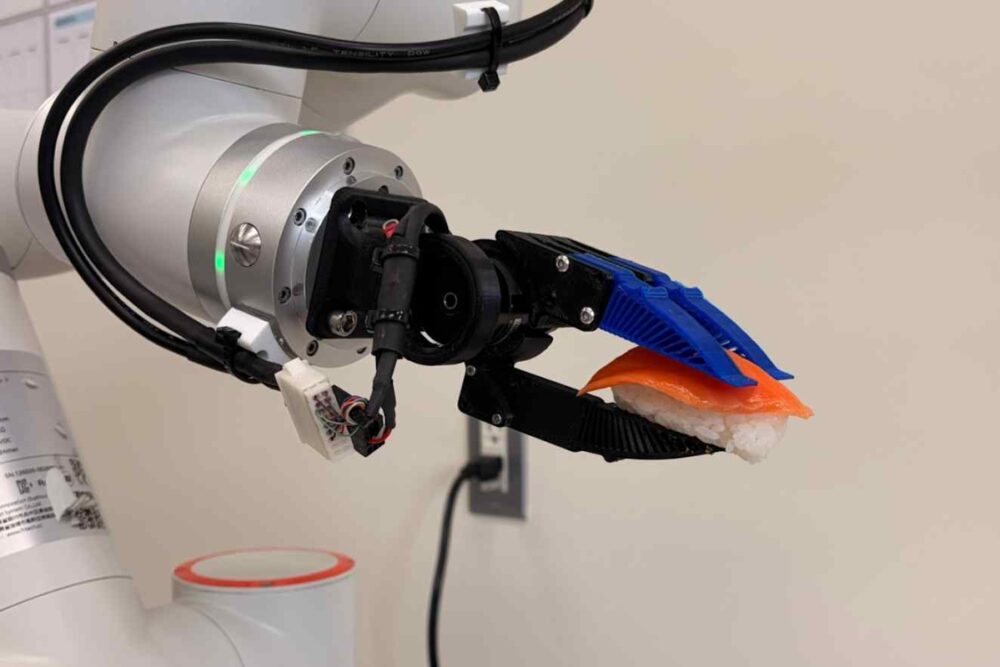
Japan’s universities are emerging as powerful centres of robotics innovation, with a growing number of startups developing artificial intelligence (AI) powered robotic arms capable of performing delicate tasks with remarkable precision.
From handling sushi and cakes to assembling tiny electronic components, these intelligent robotic systems combine advanced AI, force sensing, machine vision and dexterous manipulation technologies to perform tasks that were once considered too complex for automation.
The innovation reflects Japan’s growing focus on Physical AI, an approach that equips robots with artificial intelligence so they can interact intelligently with the physical world. Rather than concentrating solely on conversational AI or large language models, Japan is building on its long-standing expertise in robotics and precision engineering to develop intelligent machines for real-world applications.
AI Enables Human-Like Precision
Traditional industrial robots excel at repetitive tasks that follow fixed instructions. However, they often struggle with work that requires delicate handling or continuous adjustment.
The latest AI-powered robotic arms overcome these limitations by using sophisticated cameras, force sensors and machine learning algorithms to understand their surroundings in real time. They can identify objects, measure pressure and modify their movements instantly, allowing them to handle fragile materials without causing damage.
These advanced capabilities open up opportunities across a wide range of industries, including,
- Assembly of miniature electronic components
- Laboratory sample handling
- Fresh food packaging
- Recycling operations
- Pharmaceutical manufacturing
- Surgical assistance
Unlike conventional automation systems, which repeat pre-programmed movements, AI-powered robotic arms continuously improve by learning from experience.
Universities Are Driving Commercial Innovation
Many of Japan’s latest robotics breakthroughs are now moving beyond research laboratories through university spinout companies.
Years of research in robotics, artificial intelligence, biomechanics and control engineering are being transformed into commercial products that address labour shortages and improve productivity.
Working alongside manufacturers and investors, these startups are accelerating the commercialisation of technologies that previously remained within academic research. This growing ecosystem enables Japan to maintain its leadership in industrial robotics while introducing greater intelligence, flexibility and adaptability into automation.
Supporting Japan’s Physical AI Vision
The rapid development of AI-controlled robotic arms closely aligns with Japan’s national ambition to strengthen its Physical AI capabilities and reinforce its robotics leadership.
Government programmes and private investment are increasingly focused on developing AI systems that interact effectively with the physical world. Investment is also growing in robotics, multimodal AI, semiconductor infrastructure and advanced automation technologies.
AI robotic arms represent one of the earliest commercial successes emerging from this national strategy.
Benefits for Japan’s Technology Industry
The commercial success of AI robotics is expected to create significant opportunities across Japan’s technology sector.
Demand is likely to increase for,
- Machine vision systems
- AI processors
- Edge computing
- Industrial sensors
- Motion control technologies
- Robotics software
- Cloud computing platforms
- Semiconductor manufacturing
Companies specialising in industrial automation, embedded AI, cybersecurity and precision engineering are also expected to benefit as manufacturing becomes increasingly intelligent and connected.
The rise of university startups further strengthens Japan’s innovation ecosystem by encouraging collaboration between academia, industry and government research institutions.
Applications Across Multiple Industries
The new generation of AI robotic arms has applications well beyond traditional manufacturing. In electronics production, they can improve the precision of semiconductor and circuit board assembly. Within pharmaceutical manufacturing, they can automate laboratory processes and improve production accuracy.
Food manufacturers can use AI robotics to safely handle delicate products that currently require manual labour. Healthcare providers may benefit through laboratory automation, rehabilitation support and surgical assistance.
Logistics companies can automate the sorting and packing of fragile or irregularly shaped products, while agricultural businesses can use AI robots for harvesting and handling valuable crops. Small and medium-sized enterprises also stand to benefit as intelligent robotic systems become more accessible and affordable.
Strengthening Japan’s Global Robotics Leadership
Japan has long been recognised as a global leader in industrial robotics. The emergence of university startups developing AI-powered robotic arms marks the next stage of that leadership by creating intelligent, adaptive robots capable of working safely alongside people.
By combining artificial intelligence with world-class precision engineering, these companies are developing robots capable of performing tasks that traditional automation cannot achieve.
This progress complements Japan’s broader investment in Physical AI, sovereign AI models and future computing technologies.
As worldwide demand for intelligent automation continues to grow, Japan’s university startups are well positioned to become major contributors to the global robotics industry while helping address workforce shortages and supporting advances across manufacturing, healthcare, logistics and agriculture.