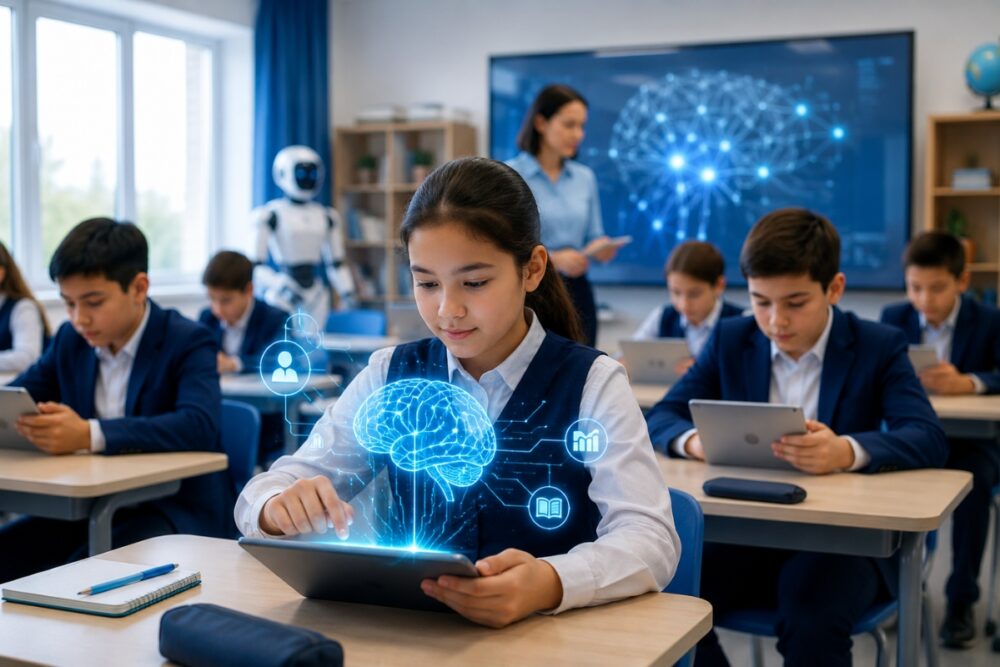
Kazakhstan is taking a significant step towards integrating AI in education after President Kassym-Jomart Tokayev signed a new decree focused on the country’s secondary school system.
The move aims to support long-term educational development while preparing students and teachers for a future increasingly shaped by artificial intelligence. Notably, the initiative combines technology investment with teacher training and safeguards for student data.
AI Rollout Aims to Improve Learning and Reduce Education Gaps
Under the new decree, the government must approve a comprehensive action plan by 1 July 2026. The strategy will guide the large-scale introduction of AI in education between 2026 and 2029. The plan will focus on personalised learning, digital infrastructure, teacher development and the protection of students’ personal information.
Additionally, the government will draw on recommendations from Kai-Fu Lee, a member of the Council for the Development of Artificial Intelligence.
For educators and school leaders, the emphasis on teacher training highlights a growing recognition that successful AI adoption depends on professional development as much as technology.
The decree also requires the government to submit proposals for a pilot project in secondary schools, with the possibility of expanding the programme nationwide.
Importantly, the initiative is designed to help reduce differences in education quality between urban and rural schools. Access to high-quality teaching and learning resources remains a challenge in many education systems, particularly in remote areas.
By 1 August 2026, participating schools are expected to receive the necessary technical equipment, including reliable high-speed internet connections. As a result, schools involved in the pilot programme will be able to test how artificial intelligence can support teaching, learning and school operations before wider implementation.
New Standards and Teacher Training
By 1 September 2026, Kazakhstan plans to introduce official standards governing the use of artificial intelligence in secondary education.
Meanwhile, a separate action plan will focus on continuous professional development for teachers. The aim is to ensure that AI becomes a useful classroom tool rather than a replacement for educators.
This approach reflects a wider international trend. Many education systems are exploring how artificial intelligence can support learning while maintaining the central role of teachers in guiding students, developing critical thinking and supporting wellbeing.
Furthermore, clear standards can help schools address concerns around ethics, data privacy and responsible technology use.
Growing Focus on AI Skills
The decree follows other efforts to expand access to artificial intelligence learning opportunities across Kazakhstan. Earlier this year, the country launched its first free AI-powered training platform designed to help students prepare for the international SAT examination.
For students, parents and educators, these developments signal a growing commitment to digital skills and future-ready learning. Ultimately, Kazakhstan’s new strategy demonstrates how governments are beginning to move from discussions about artificial intelligence to practical implementation within schools.