The Hong Kong University of Science and Technology (HKUST) is offering educators hands-on training in AI-assisted course design through its AI Co-designer platform. The workshop will help instructors develop learning outcomes, assessments and classroom activities while improving the alignment between different course components.
Developed by HKUST’s Centre for Education Innovation (CEI), the AI Co-designer acts as an instructional design partner. It supports educators in planning courses, creating assessment materials and developing engaging learning activities.
Course design requires instructors to balance academic objectives, assessment methods and student engagement. However, bringing all these elements together can be time-consuming.
Through the platform, HKUST aims to simplify this process and give educators more time to focus on teaching and student learning.
How HKUST’s AI Co-Designer Supports Course Planning
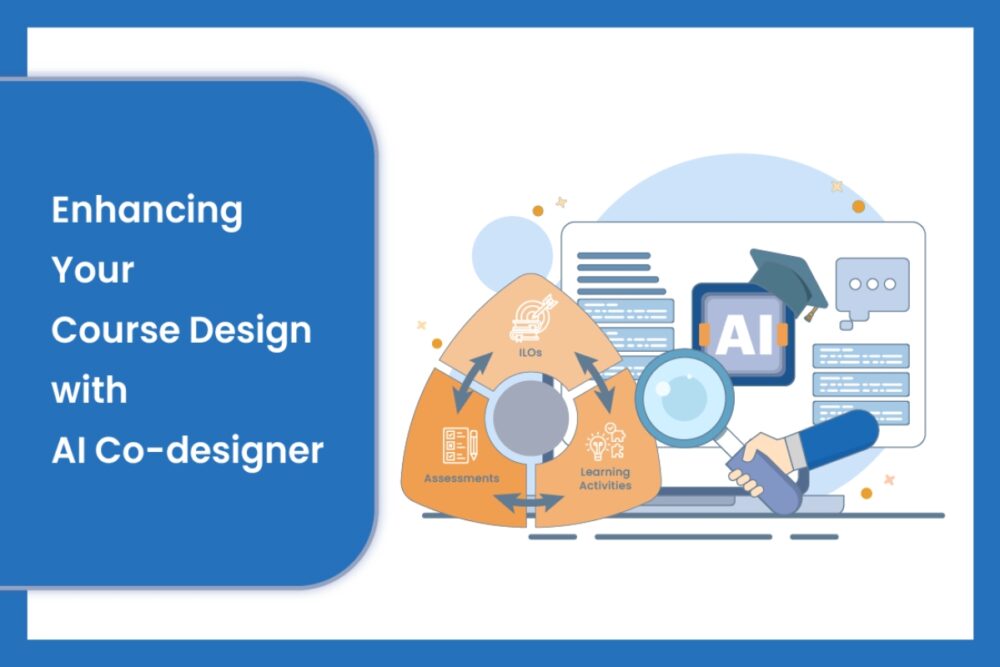
The AI Co-designer helps instructors develop different elements of a course, including intended learning outcomes (ILOs), assessments, marking rubrics and learning activities.
Additionally, it allows educators to examine how these components connect through constructive alignment, ensuring that teaching activities and assessments support the intended learning outcomes.
The platform offers several practical benefits,
- Streamlining individual and collaborative course design workflows.
- Evaluating constructive alignment through built-in pedagogical frameworks.
- Reducing time spent on routine course planning.
- Supporting the development of engaging learning experiences.
For example, an instructor could use the platform to develop assessment activities that measure students’ critical thinking skills. They could then review whether those activities align with the course’s learning objectives.
However, educators remain responsible for evaluating the quality and relevance of AI-generated content.
What Educators Will Learn During The AI Co-Designer Workshop
The interactive workshop is designed to give instructors practical experience using the platform.
By the end of the session, participants will be able to,
- Describe the features and workflow of the AI Co-designer.
- Use prompts to generate course components and constructive alignment mapping tables based on user materials.
- Apply prompt engineering techniques for iterative content refinement.
- Evaluate the applicability and relevance of generated responses using built-in reflection questions.
- Retrieve generated course components from course conversation and syllabus files.
These skills will help educators understand how to use AI beyond generating basic teaching materials.
In particular, prompt engineering and iterative refinement can help instructors improve the quality of generated content. Meanwhile, constructive alignment mapping can support more consistent course planning.
HKUST AI Co-Designer Workshop Dates And Registration
HKUST is offering four workshop sessions during Fall 2026. The first three sessions have closed registration, while the fourth provides another opportunity for educators to participate.
The workshop details are as follows,
| Workshop Details | Information |
|---|---|
| Facilitators | Ronald Chow and Lya Li |
| Time | 12:30 pm to 2:00 pm |
| Venue | Learning Forum, RM 6558, Lift 27–30 |
| Programme | Academy of Education Excellence (AEE) |
| Recognition | Official AEE badge upon completion |
Workshop Schedule
| Session | Date | Registration Status |
|---|---|---|
| First Run | 9 September 2026 | Registration Closed |
| Second Run | 17 September 2026 | Registration Closed |
| Third Run | 27 October 2026 | Registration Closed |
| Fourth Run | 12 November 2026 | Registration Available |
Educators interested in attending can register through the official HKUST event page.
AI Co-Designer Receives International Education Recognition
The platform has also received recognition from international education and technology organisations.
It was shortlisted for the QS Reimagine Education Awards in 2024 under AI in Education and again in 2025 under Best Use of Generative AI.
Additionally, it received the Excellence in Educational Impact Award at the AIREA 2nd International Competition on AI in Education 2026, in the Use of Generative AI category.
The platform is also a finalist for the eLFA 2026 Teaching Innovation Award. Furthermore, it features in the Digital Education Council’s Best Practices Collection under Curriculum and Learning Design.
These achievements reflect growing interest in practical applications of AI within higher education. They also highlight how universities are exploring ways to support educators in course planning and academic development.
Why AI-Assisted Course Design Matters For Educators
AI tools are becoming increasingly common in higher education. However, their value depends on how effectively educators integrate them into teaching and assessment.
Course design involves more than preparing lesson materials. Instructors must establish clear objectives, select appropriate teaching methods and ensure assessments measure the intended skills.
AI-assisted platforms can help organise these processes. Nevertheless, educators must retain control over academic decisions and ensure that learning materials meet students’ needs.
HKUST is developing its AI Co-designer specifically for its instructors. Therefore, feedback from academic staff will remain important in refining the platform.
The workshop offers an opportunity to explore these applications through practical exercises. It also gives educators a chance to develop skills in prompt engineering, course alignment and evaluating AI-generated responses.
Ultimately, the aim is to make course planning more manageable while allowing educators to concentrate on meaningful teaching and student engagement.