Nanyang Technological University (NTU Singapore) and Google are expanding their AI partnership to give students, educators and researchers greater access to artificial intelligence tools, training and research opportunities.
The collaboration aims to strengthen AI adoption across higher education, scientific research and workforce development. It also supports Singapore’s ambitions to develop local AI capabilities and prepare graduates for an increasingly AI-enabled workplace.
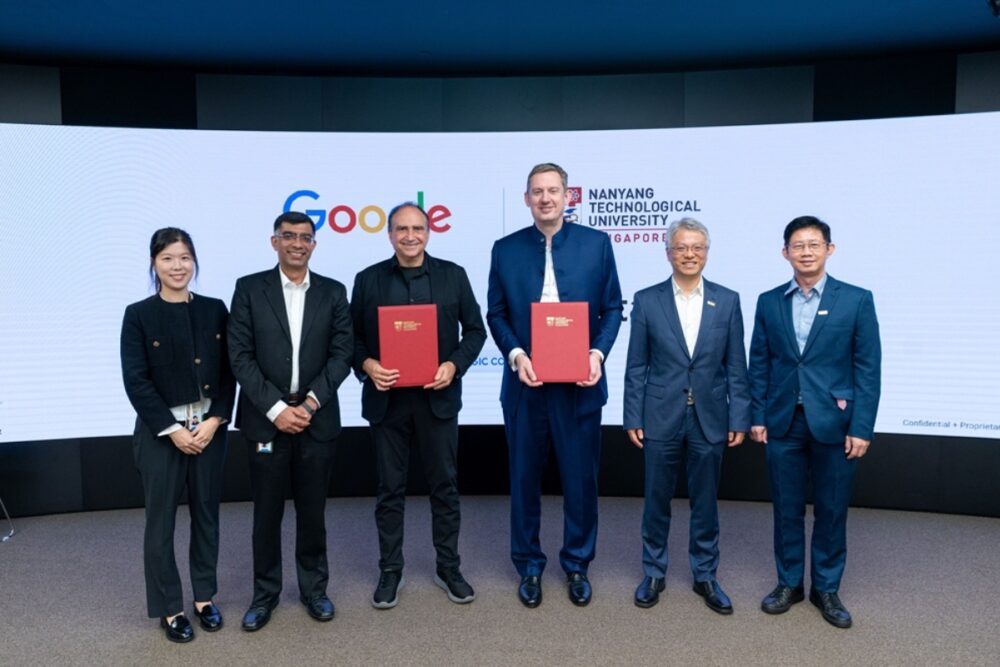
The expanded partnership was formalised through a Memorandum of Understanding (MOU), signed by NTU Provost and Deputy President Professor Christian Wolfrum and Yossi Matias, Vice President of Google and General Manager of Google Research.
The agreement covers four areas, campus-wide AI integration, regional language development, advanced scientific research and AI safety.
It will also support faculty development, professional training and industry-recognised certifications.
NTU And Google Partnership Expands AI Access For Students
The agreement builds on an existing collaboration between NTU and Google. Since August 2026, NTU undergraduates have had full access to a suite of premium Google AI tools.
These include Gemini Enterprise, Google AI Studio and Vertex AI. The expanded access gives students opportunities to explore AI applications across their studies and develop practical digital skills.
Professor Christian Wolfrum said,
“Our expanded partnership with Google provides our students, faculty, and researchers with access to frontier tools and secure cloud infrastructure. Embedding AI across NTU’s curriculum and research ecosystem provides a key differentiator in how we prepare our community for an AI-enabled future. By combining Google’s technological capabilities with NTU’s academic and scientific strengths, we can co-develop impactful applications, from preserving Southeast Asian languages to discovering new scientific insights, while upholding the highest standards of safety and responsibility.”
For students, the collaboration extends beyond access to technology. It aims to develop the ability to use AI responsibly, assess information and apply emerging tools to academic and professional challenges.
AI Integration To Reach 40% Of Undergraduate Courses By 2030
One of the partnership’s main education objectives is to embed AI into 40% of NTU’s undergraduate courses by 2030.
To support this target, NTU will introduce structured AI training for faculty members and educators. The programmes will help academic staff develop confidence in using AI across teaching, assessment and research.
Additionally, the university will explore integrating Gemini Enterprise with NTU Learn, its learning management platform.
The proposed integration could turn teaching materials and course content into secure, searchable knowledge sources that students and educators can access through AI.
For example, educators could develop AI assistants to help students navigate course materials. They could also work with postgraduate researchers to adapt research activities into classroom learning.
Students, meanwhile, could use AI agents to compare academic papers, examine datasets and evaluate research findings. They would still need to explain their conclusions and check the accuracy of AI-generated results.
The partnership also introduces the Google AI Educator Series. This will offer stackable, badge-accredited training to strengthen educators’ AI skills and help reduce administrative workloads.
Furthermore, academic staff will have opportunities to pursue Google for Education Certifications to demonstrate their digital literacy.
Developing AI Models For Southeast Asian Languages
Another important part of the agreement focuses on making AI more relevant to Southeast Asia’s linguistic and cultural diversity.
NTU and Google will work with AI Singapore (AISG) on regional language initiatives through Projects ATLAS and Amplify.
The projects will focus on collecting, cataloguing and open-sourcing datasets that reflect the region’s languages and linguistic differences.
This work is important because AI systems trained primarily on widely represented languages may not adequately understand regional expressions, cultural references and local contexts.
AISG will also continue developing independent evaluation and benchmarking frameworks. These will assess both frontier and open AI models against Southeast Asian cultural and linguistic requirements.
In addition, NTU and Google will explore sovereign AI models for education and healthcare. These could incorporate regional languages using Google’s open-weight models, including Gemma and MedMedma.
The longer-term objective is to support AI applications that better reflect the needs of Southeast Asian communities.
Google Cloud To Support Scientific Research At NTU
The partnership will also strengthen NTU’s research infrastructure through Google Cloud Platform.
The university plans to develop a secure research sandbox with architectural guidance from Google. This will allow researchers to launch pre-approved computing environments when needed.
The system aims to reduce delays associated with setting up IT infrastructure for research projects.
It could also provide access to Google’s latest AI technologies and create a secure environment for collaboration with external research partners.
For example, researchers could use AI and data-analysis tools to examine approved datasets. They could then share selected information with authorised collaborators while maintaining permissions and data separation.
Additionally, the agreement creates opportunities for academic research collaboration between NTU and Google Research across the Asia-Pacific region.
These efforts will complement existing initiatives involving Google DeepMind.
NTU researchers may also gain early access to relevant research programmes, including Google’s AI Hypothesis Generation system. The system is designed to accelerate the evaluation of emerging AI capabilities for scientific discovery.
AI Safety And Data Privacy Form Part Of The Agreement
Alongside expanding AI access, NTU and Google will investigate privacy, safety and security challenges associated with advanced AI systems.
Joint research teams will examine full-stack AI infrastructure protection, with particular attention to safeguarding data against future threats.
The research will cover post-quantum cryptography, deepfake detection and cryptographic protections for model privacy.
These areas are becoming increasingly important as universities adopt AI across teaching, research and administrative operations.
For students and educators, responsible AI use also involves understanding data protection, checking the reliability of generated information and recognising potential risks.
Yossi Matias said,
“Singapore isn’t just adopting AI research, it is helping define how this technology serves science and society. Sustaining that momentum requires long-term investment in local talent and a deep commitment to building responsibly. Our expanded partnership with NTU brings both together, giving Singapore’s researchers the resources to push scientific boundaries and turn breakthroughs into real-world impact in education and healthcare.
Preparing Students And Educators For An AI-Enabled Future
The expanded NTU and Google partnership reflects a broader shift in higher education. Universities are moving beyond introducing standalone AI courses towards integrating the technology into teaching, research and everyday academic activities.
For students, this means developing skills to work alongside AI tools while retaining the ability to evaluate evidence and think independently.
For educators, it creates opportunities to rethink lesson planning, research activities and academic support. However, effective implementation will depend on training, appropriate safeguards and clear expectations around responsible use.
The partnership’s progress will ultimately depend on how these commitments translate into everyday learning experiences and research outcomes.
NTU’s target of integrating AI into 40% of undergraduate courses by 2030 provides a measurable direction. Meanwhile, its work with Google and AI Singapore could contribute to AI tools that better serve Southeast Asian languages and communities.
Together, these initiatives position AI education, research capability and responsible technology development as central priorities for the university’s future.