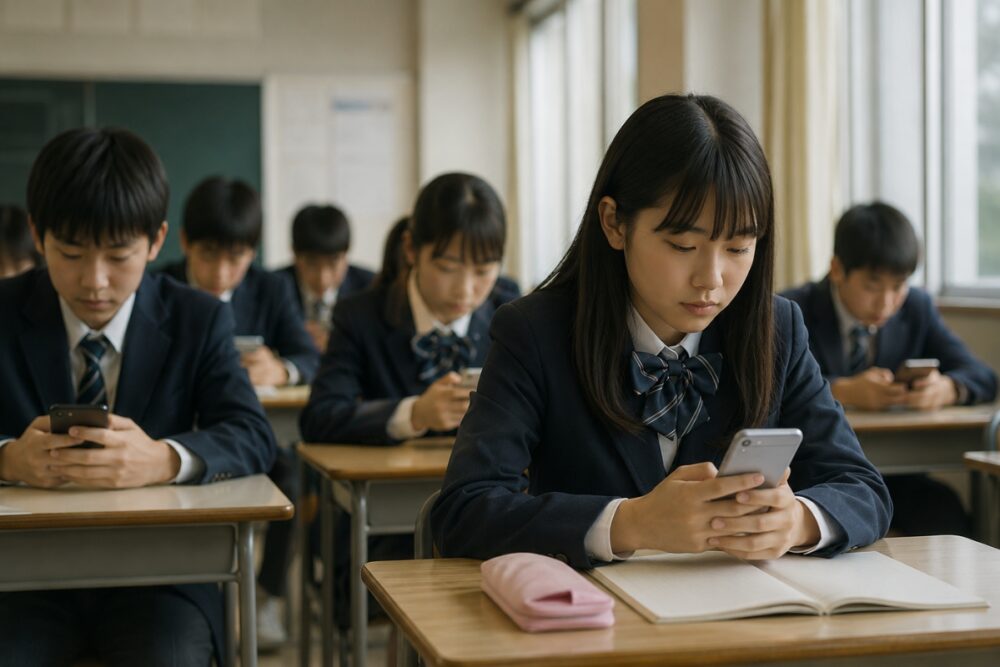
Students in Japan who spend more time on social media and watching videos tend to record lower test scores, according to an analysis of the country’s 2026 national academic assessment.
The findings highlight a growing concern for parents, educators and school leaders as digital device use becomes increasingly common among children. The analysis found a clear association between longer weekday use of social media and video services and lower rates of correct answers across subjects.
The Ministry of Education, Culture, Sports, Science and Technology combined students’ questionnaire responses with their results from the 2026 National Assessment of Academic Ability and Learning Situation.
The assessment covered sixth-grade elementary school students and third-year junior high school students. MEXT says the 2026 assessment included tests in Japanese, arithmetic or mathematics and English for eligible junior high school students.
Social Media And Video Use Rises Among Students
The proportion of third-year junior high school students who said they spend at least three hours each weekday on social media or watching videos reached 49.1%.
That represents a rise of 17 percentage points from fiscal 2024. Among sixth-graders, the figure reached 37.3%, increasing by 16.8 percentage points over the same period.
Importantly, the ministry excluded time spent using devices for study or playing video games from this measure. The findings therefore focus on recreational use of social media and video content rather than digital learning.
The results show that the longer students spent socialising online or watching videos, the lower their rates of correct answers tended to be across subjects.
Smartphone Access Is Becoming Almost Universal
The growth in screen use is also reflected in smartphone access among younger pupils. Only 4.5% of sixth-graders said they did not have a smartphone or similar device. This was a sharp decline of 16.6 percentage points compared with two years earlier.
Among junior high school students, just 1.0% reported not having such a device, down 2.4 percentage points. As a result, access to connected devices is now widespread among Japanese pupils.
For parents and schools, the findings suggest that the question is no longer simply whether children have access to smartphones. Instead, attention is increasingly shifting towards how much time they spend using them and how that time fits alongside learning.
Four Hours Of Use Linked To A Wide Maths Gap
The assessment revealed a particularly wide difference in mathematics performance.
Among students who said they used social media or watched videos for four hours or more each weekday, the rate of correct answers in arithmetic was 47.7% among sixth-graders. For third-year junior high school students, the figure was 48.7%.
By comparison, students who spent less than 30 minutes on these activities recorded correct answer rates of 68.6% among sixth-graders and 69.6% among junior high school students. The gap was therefore more than 20 percentage points for both groups.
These figures show an association rather than proving that social media or video use directly causes lower academic performance. Other factors, including study habits, sleep, family circumstances and motivation, may also influence results.
For educators, however, the relationship is significant enough to warrant attention when discussing students’ wider learning routines.
Study Time Outside School Is Also Falling
The analysis also found a decline in the amount of time students spend studying outside school. Since fiscal 2021, study time has fallen among both elementary and junior high school students on weekdays and weekends.
In the latest survey, 61.7% of junior high school students said they studied for at least one hour on a weekday outside school hours. Among elementary school students, the figure was 50.3%.
Compared with fiscal 2021, this represents a decline of 14.1 percentage points for junior high school students and 12.5 percentage points for elementary school students. The pattern was even more pronounced at weekends.
Some 52.8% of junior high school students and 39.4% of elementary school students said they studied for at least one hour on a weekend day. Those figures were down 24.8 percentage points and 21.8 percentage points respectively from fiscal 2021.
| Finding | Sixth-Grade Students | Third-Year Junior High Students |
|---|---|---|
| Spend 3+ hours on social media or videos per weekday | 37.3% | 49.1% |
| Increase since fiscal 2024 | +16.8 percentage points | +17 percentage points |
| Spend 4+ hours on social media or videos per weekday | 21.7% | 28.5% |
| Increase in 4+ hour use since fiscal 2024 | +9.9 percentage points | +10.6 percentage points |
| Do not have a smartphone or similar device | 4.5% | 1.0% |
| Change in students without a device since fiscal 2024 | -16.6 percentage points | -2.4 percentage points |
| Maths/arithmetic correct answers with 4+ hours of use | 47.7% | 48.7% |
| Maths/arithmetic correct answers with less than 30 minutes of use | 68.6% | 69.6% |
| Study for 1+ hour outside school on weekdays | 50.3% | 61.7% |
| Study for 1+ hour outside school on weekends | 39.4% | 52.8% |
| Decline in weekday study time since fiscal 2021 | -12.5 percentage points | -14.1 percentage points |
| Decline in weekend study time since fiscal 2021 | -21.8 percentage points | -24.8 percentage points |
Family Conversations Could Support Study Habits
The findings also point to the importance of family involvement in learning. Around 70% of students said they talked about schoolwork with their families once or twice a week or almost every day.
Students who discussed schoolwork with their families also tended to spend more time studying outside school on weekdays.
For parents, this provides a useful reminder that academic support does not always require additional tutoring or structured lessons.
Simple conversations about schoolwork can help parents understand what children are learning, where they may need support and how they are managing their time. Meanwhile, schools can encourage families to make these conversations part of regular home routines.
What The Findings Mean For Schools And Families
The Japanese findings offer a wider lesson for education communities dealing with increasing digital access. Smartphones and online videos are now part of many children’s everyday lives. Digital platforms can also support learning, communication and creativity.
However, the latest assessment suggests that recreational screen time needs to be considered alongside study time and other aspects of students’ daily routines. Parents may benefit from setting clear expectations around weekday device use. Schools can also help families understand the difference between productive digital learning and extended recreational use.
Furthermore, educators can encourage students to reflect on how they divide their time between study, entertainment, social interaction and rest.
| Area | Key Takeaway |
|---|---|
| Screen time | Longer recreational use of social media and videos was associated with lower test performance. |
| Maths performance | Students using these services for 4+ hours had correct-answer rates more than 20 percentage points lower than those using them for less than 30 minutes. |
| Smartphone access | Smartphone or similar device ownership has become widespread, particularly among junior high school students. |
| Study habits | Time spent studying outside school has declined considerably since fiscal 2021. |
| Family involvement | Students who regularly discuss schoolwork with their families tend to spend more time studying outside school. |
| Implication for parents | Families may benefit from setting clear boundaries around recreational screen use and protecting study time. |
| Implication for schools | Schools can support students and families with guidance on healthy digital habits and balanced routines. |
MEXT says the national assessment is designed not only to understand students’ academic achievement but also to analyse learning conditions and support improvements in education and learning.
The 2026 assessment was conducted between April 20 and May 29, with the ministry publishing national results in stages. The second stage, which included analysis based on national data, was scheduled for August 3.
For parents and educators, the message is not simply to remove smartphones from children’s lives. Instead, the findings underline the importance of helping students develop healthy digital habits while protecting time for study, family interaction and other activities that support learning.