
The findings concern new enrolments at responding institutions, providing an early indicator of recruitment patterns rather than a complete count of international students.
Asian universities responding to a new international enrolment survey reported growth in postgraduate recruitment, with 59 per cent recording an increase for the August–October 2026 intake.
The Global Enrolment Benchmark Survey, conducted by Studyportals with NAFSA and Oxford Test of English, gathered responses from 437 institutions in 63 countries.
Among Asian respondents, the average change in new international postgraduate enrolments was an increase of 7 per cent. Six in ten expected enrolments to grow for the equivalent intake next year, although that is a forecast rather than an observed result.
How Asia Compares With Other Destinations
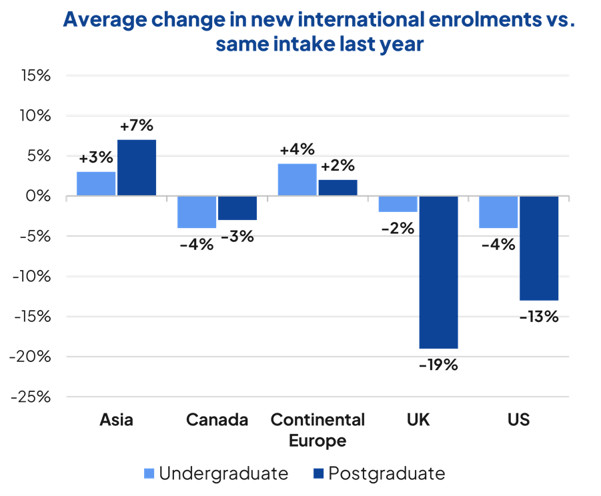
The published comparison chart shows different patterns across the destinations surveyed. Asian institutions reported an average undergraduate increase of 3 per cent, while continental European respondents recorded growth of 4 per cent at undergraduate level and 2 per cent at postgraduate level.
The UK’s average postgraduate change was a decline of 19 per cent, compared with 13 per cent in the US. Canada recorded smaller average decreases of 4 per cent for undergraduates and 3 per cent for postgraduates.
Across the US, UK, Canada and Australia, 62 per cent of respondents reported lower postgraduate enrolments. The corresponding figure for undergraduate enrolments was 46 per cent, illustrating why the level of study matters when interpreting the results.
What the Findings Mean for University Planning
The survey’s accompanying summary identifies visas and government policy as the most frequently cited recruitment obstacle. It also reports that institutions credited their own recruitment and marketing activity among the positive influences on enrolments.
The results are based on institutional responses. They do not establish that a particular student switched from an English-speaking destination to Asia, or that every Asian country experienced the same trend.
For school counsellors and prospective applicants, the findings offer context for exploring university destinations. They do not rank institutions or replace checks on individual programmes, entry requirements and costs.
A regional average describes the survey group; it does not predict the experience of a particular university or applicant.
Explore the survey summary and its published comparisons on Studyportals.